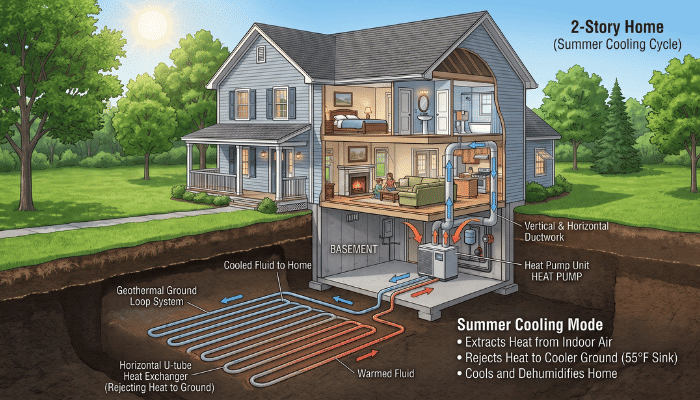
If you have ever wondered how a single system can both heat and cool your home using the ground beneath your feet, geothermal is worth understanding. At Lanz, we install and service geothermal systems across Champaign County, and they remain one of the most efficient comfort options available for homes in our area. Because central Illinois has plenty of open land and a climate with cold winters and hot, humid summers, it is an especially good fit for the technology. Here is a plain-language look at how geothermal works, why it suits our region, and what to expect if you are considering it.
What a Geothermal System Actually Is
A geothermal system, sometimes called a ground-source heat pump, does not burn fuel to create heat. Instead, it moves heat between your home and the earth. A few feet below the surface, the ground in central Illinois stays at a steady temperature of roughly 50 to 55 degrees all year, no matter how cold or hot it gets outside. A geothermal heat pump taps into that stable temperature to warm your home in winter and cool it in summer.
- In winter, the system pulls warmth from the ground and moves it indoors.
- In summer, it reverses, pulling heat out of your home and releasing it back into the cooler ground.
How the Ground Loop Works
The heart of a geothermal system is a buried loop of piping filled with a water-based solution. This loop is what exchanges heat with the earth. There are two common configurations:
- Horizontal loops, which are laid in trenches several feet deep. These are popular on rural and larger suburban lots around Champaign County because they take advantage of available land.
- Vertical loops, which are drilled straight down in boreholes. These are used when yard space is limited, such as on smaller city lots in Champaign or Urbana.
The fluid circulates through the loop, absorbs or releases heat, and returns to the indoor unit, which distributes conditioned air through your home much like a conventional system.
Why Central Illinois Is a Strong Fit
Our region has a few things going for it when it comes to geothermal:
- Land availability. Many properties in and around Champaign County have room for a horizontal loop, which is typically the most cost-effective option.
- A demanding climate. Because we swing from bitter winters to hot, sticky summers, an efficient system that handles both heating and air conditioning pays off over the long run.
- Stable soil temperatures. The consistent ground temperature below the frost line gives the system a reliable source to draw from in every season.
Geothermal Compared to a Traditional Furnace and AC
A standard furnace creates heat by burning gas, and a standard air conditioner rejects heat outdoors through a condenser. Geothermal is different in a few important ways:
| Geothermal System | Traditional Furnace + AC | |
|---|---|---|
| How it works | Moves existing heat between your home and the ground | Burns gas for heat, uses an outdoor condenser for cooling |
| Efficiency | Delivers several units of heating or cooling per unit of electricity | Limited by how much fuel is burned |
| Equipment lifespan | Indoor unit 20 to 25 years; ground loop 50+ years | Furnace roughly 15 to 20 years; AC roughly 12 to 15 years |
| Comfort | Steady, even temperatures with less cycling | More noticeable temperature swings and cycling |
| Noise | No outdoor condenser, very quiet | Outdoor condenser runs during operation |
| Upfront cost | Higher | Lower |
| Operating cost | Lower over the long run | Higher over the long run |
What Installation Involves
Installing geothermal is a bigger project than swapping out a furnace, and it is worth knowing what to expect. Our team evaluates your property, your heating and cooling needs, and your available land to recommend the right loop design. From there, the loop is installed, connected to the indoor heat pump, and tied into your home's distribution system. Because every home and lot is different, the best first step is a professional assessment. You can request an evaluation online and we will walk you through your options.
Is Geothermal Worth the Investment?
Geothermal typically costs more upfront than a conventional system, but it often makes that back through lower monthly energy bills and a long service life. Financing can make the upfront cost more manageable, and we offer financing options to help spread it out. Federal tax incentives have historically been available for residential geothermal installations as well, so it is worth confirming current eligibility before you decide. Pairing a new system with a Lanz Comfort Family maintenance plan also helps protect your investment over the years.
Thinking about whether geothermal is right for your home? The Lanz team has served Champaign County since 2002 and can help you weigh your options with a no-pressure evaluation. Call 217-394-1380 or schedule service online today.
The indoor heat pump commonly lasts 20 to 25 years, while the buried ground loop can last 50 years or more, which is well beyond the lifespan of a typical furnace or air conditioner.
Yes. Because the loop draws from the stable ground temperature below the frost line rather than the freezing outdoor air, geothermal keeps working efficiently even during our coldest stretches.
Not necessarily. Horizontal loops use more space and suit rural and larger lots, but vertical loops are drilled deep and work well on smaller city lots where yard space is limited.
No. There is no large outdoor condenser, so geothermal runs quietly compared to conventional air conditioning.